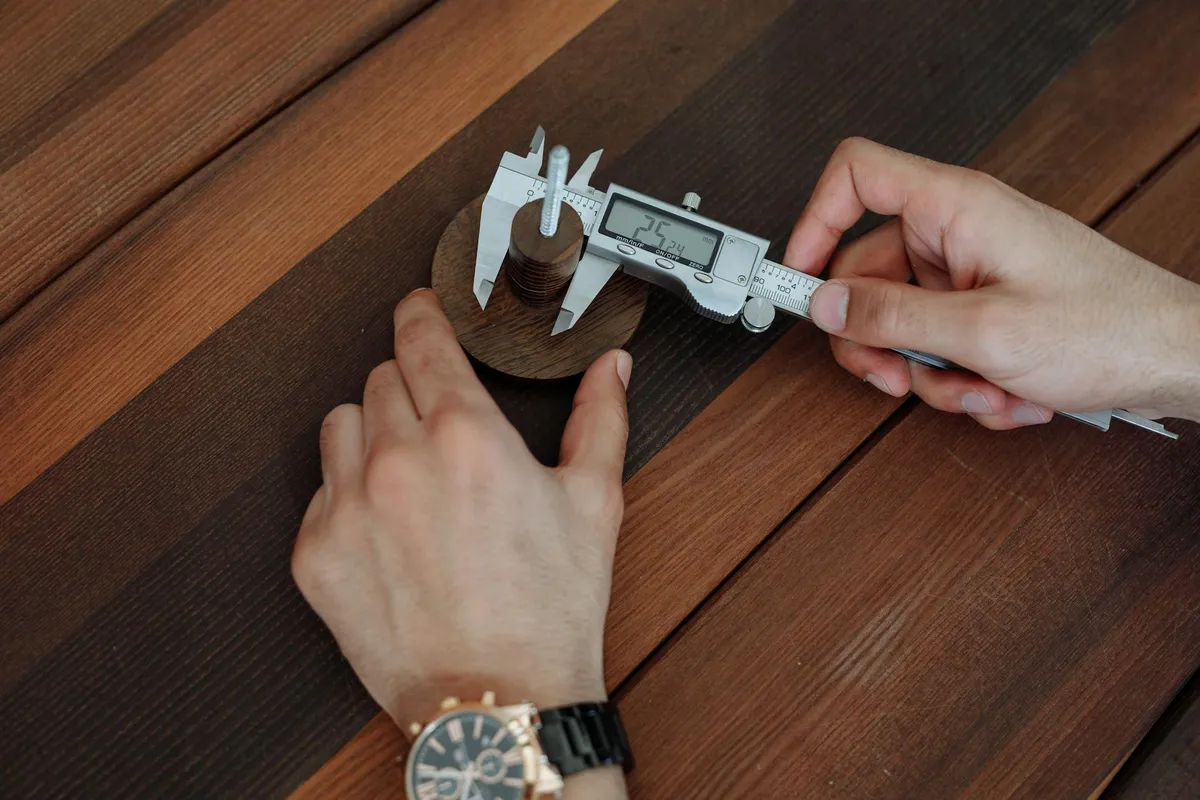
When we say that something is one meter long, we are making a claim. The claim has a history. The meter, as a unit, has been defined and redefined several times over the past two centuries, each time becoming more precise and more independent of physical artifacts.
The current definition: the meter is the distance light travels in vacuum during 1/299,792,458 of a second. This is a peculiar definition. It defines length in terms of light and time. Both are measurable to extraordinary precision. The meter inherits that precision.
The history of this definition reveals something interesting about measurement itself.
What measurement actually is
Measurement is the operation of comparing a property of an object to a standard, expressing the result as a numerical multiple of the standard. Length measurement compares an object to a length standard. Mass measurement to a mass standard. Time measurement to a time standard.
The standards are the foundation. If the standard is poorly defined, ambiguously specified, or unstable over time, all measurements based on it inherit those problems. If the standard is well-defined, unambiguous, and stable, measurements can be progressively refined toward arbitrary precision.
This is why the metrological community has invested enormous effort over centuries in defining and progressively refining the basic standards. The current set — the International System of Units, or SI — represents the contemporary state of this multi-century project.
The progressive refinement of the meter
The meter has been defined and redefined four times since its initial definition in 1791:
1791: The meter was defined as one ten-millionth of the distance from the equator to the North Pole along a meridian through Paris. This required an enormous geodetic survey to actually measure. The result was approximate.
1889: The meter was redefined as the length of a specific platinum-iridium bar held at the International Bureau of Weights and Measures in Sèvres, France. This was more reproducible than the geodetic definition but depended on a single physical artifact whose stability was uncertain.
1960: The meter was redefined as 1,650,763.73 wavelengths of a specific spectral line of krypton-86. This severed the dependence on a physical artifact and allowed any properly equipped laboratory to realize the definition independently.
1983: The meter was redefined as the distance light travels in vacuum during 1/299,792,458 of a second. This made the definition depend on the (already extremely precise) measurement of time and the (now defined as exact) speed of light.
Each redefinition increased the precision and stability of the meter. The contemporary definition is essentially perfect for all practical purposes — limited only by our ability to measure time, which is measurable to roughly one part in 10^18.
The kilogram problem
The kilogram had a peculiar history. Until 2019, the kilogram was defined as the mass of a specific platinum-iridium cylinder kept at the International Bureau of Weights and Measures. The cylinder had been the standard since 1889. It was the last SI unit defined by reference to a physical artifact.
The problem: the cylinder's mass appeared to be drifting over time, by perhaps tens of micrograms per century. This was problematic because the cylinder's mass was the kilogram by definition. If the cylinder drifted, the kilogram drifted. There was no external reference against which to compare.
In 2019, the kilogram was redefined in terms of fundamental physical constants — specifically, by fixing the value of the Planck constant. This required developing extremely precise instruments (the "Kibble balance") capable of relating mass to electrical measurements derived from quantum effects.
The redefinition severed the kilogram's dependence on a physical artifact and tied it to constants of nature that are (presumed to be) stable across time and space.
What this teaches about knowledge
The history of metrology reveals something philosophically interesting about scientific knowledge. To know a quantity precisely requires that the unit of measurement be precisely defined. The unit must, in turn, be defined in terms of something stable and reproducible.
For most of human history, units were defined by reference to convenient physical things — body parts (foot, hand, span), specific objects (the king's yard), or specific physical artifacts. Each had limitations: variability, instability, single point of failure.
The progressive refinement of the SI units toward fundamental physical constants represents the contemporary solution to these limitations. The units are now defined in terms of things presumed stable across time and space — the speed of light, fundamental quantum constants, atomic transition frequencies.
If those underlying constants are in fact stable (which is what the physics suggests), then the units derived from them are also stable. Measurements made today with properly realized units should be comparable to measurements made in a thousand years.
The practical implications
The precision of contemporary metrology supports much of contemporary technology. GPS navigation depends on extremely precise time measurement (and accounting for relativistic effects on clocks in different gravitational potentials). Modern manufacturing depends on length measurements precise to fractions of a wavelength of light. Modern electronics depend on voltage measurements precise to parts in 10^9.
None of this would be possible without the metrological infrastructure that progressively refines the underlying units and the instruments that realize them.
This is, like much foundational scientific work, mostly invisible to the technologies it enables. People use GPS without knowing about cesium atomic clocks. People use calibrated instruments without knowing about the specific procedures by which calibration is traceable to fundamental units.
The limits of measurement
Metrology has its limits. At sufficiently small scales, quantum mechanical effects impose fundamental limits on simultaneous measurement of certain quantity pairs (most famously, position and momentum). At sufficiently large scales, observational limits on measuring distant phenomena become absolute.
For most practical purposes, however, the limits are well above what is needed. The measurements that enable contemporary technology are precise to far better than the technology itself requires. The investment in metrological precision pays back through downstream applications that depend on it.
A closing observation
I find metrology interesting partly because it is one of those domains where extreme precision is pursued for its own sake, and the precision then enables technologies that the original metrologists did not foresee.
The kilogram is now defined by quantum effects. The meter is now defined by light. The second is now defined by atomic transitions. These definitions support the navigation systems, the communication systems, the manufacturing systems, the scientific instruments, the medical devices, and the financial systems of contemporary life.
The work of measurement continues, quietly, in metrology institutes most people have never heard of, supporting the precision that makes much of contemporary life possible.