The thermometer is now so ordinary that it barely registers as an instrument. We use them to check fevers, monitor refrigerators, regulate ovens, and calibrate building HVAC systems. They cost a few dollars and work essentially perfectly.
This was not always the case. The thermometer took roughly two centuries to develop from an early curiosity to a reliable precision instrument. The history reveals something about how scientific instruments actually mature, and about the patient work that goes into making mundane measurements reliable.
The early instruments
The earliest thermometers, developed in the late sixteenth and early seventeenth centuries, were called thermoscopes — they showed that something was hotter or colder, but did not produce numerical readings. Galileo developed an early thermoscope using a glass bulb with a thin tube containing colored water. As the air in the bulb warmed and cooled, the water level in the tube changed.
The instrument was qualitative rather than quantitative. It also responded to atmospheric pressure as much as to temperature, conflating two effects.
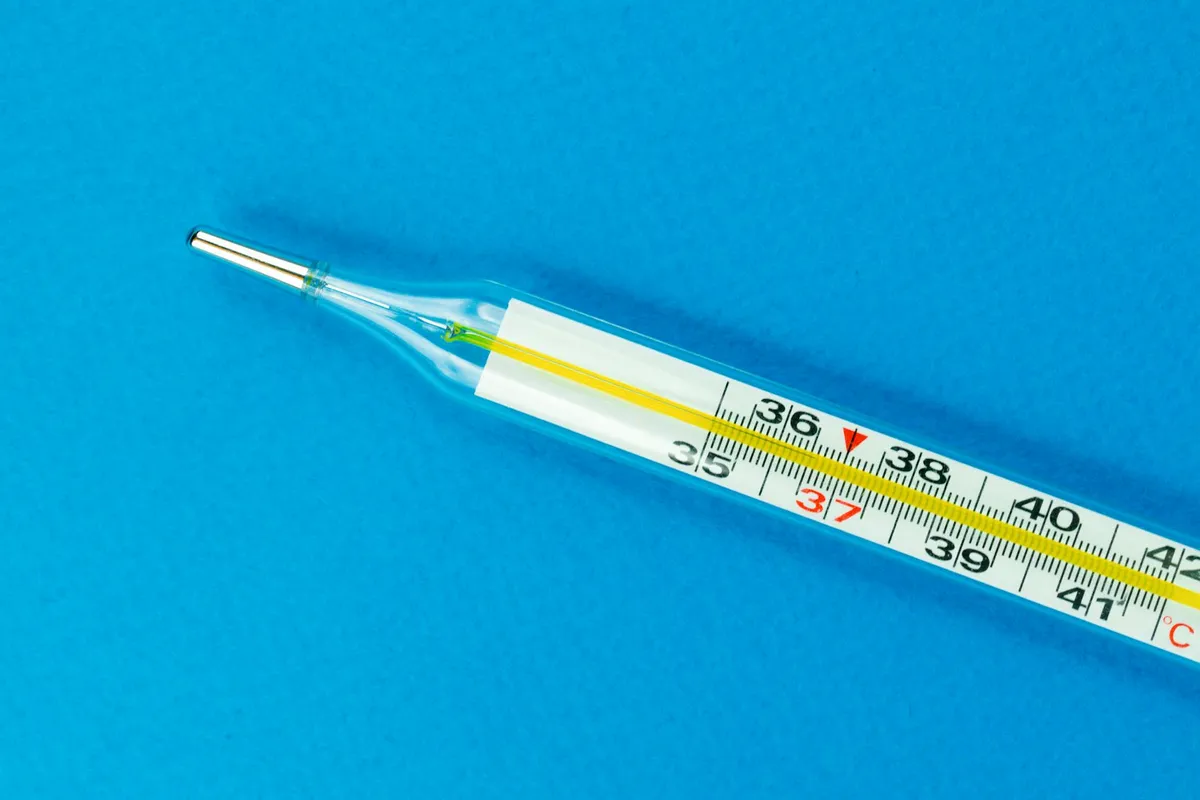
By the mid-seventeenth century, sealed liquid thermometers had been developed that responded only to temperature. These used colored alcohol or, later, mercury as the liquid. The bulb-and-tube design we now recognize was established by the late seventeenth century.
The standardization problem
Even with the basic instrument design established, thermometers remained essentially incomparable through the seventeenth and early eighteenth centuries. Each maker chose their own scale. The same temperature might read as one number on one thermometer and a different number on another. The instrument worked, but the readings were not comparable across instruments.
The solution required defining standardized scales tied to reproducible physical phenomena. The most influential proposals:
Daniel Gabriel Fahrenheit (1714): proposed a scale with three reference points — the temperature of an ice/salt mixture (0°F), the freezing point of water (32°F), and human body temperature (96°F, later refined to 98.6°F). This became the standard scale in English-speaking countries.
Anders Celsius (1742): proposed a scale with two reference points — the freezing point of water (originally 100°C, later inverted to 0°C) and the boiling point of water (originally 0°C, later inverted to 100°C). This became the standard scale in most of the world.
William Thomson (Lord Kelvin) (1848): proposed an absolute scale with zero at the lowest possible temperature (absolute zero, -273.15°C). This became the standard scientific scale.
The development of these scales took most of a century after the basic instrument design was established. The scales themselves required the development of precise glass-blowing, precise calibration methods, and reliable measurement of the fixed-point temperatures.
The precision problem
Even with standardized scales, eighteenth-century thermometers were limited in precision by the consistency of their construction. The bore of the glass tube needed to be uniform. The bulb needed to be reliably reproducible. The liquid needed to behave consistently across the temperature range. Small variations in any of these produced reading errors.
Through the nineteenth century, instrument makers progressively refined construction techniques. Glass production became more uniform. Bore measurements became more precise. Calibration procedures became more rigorous. The achievable precision of laboratory thermometers improved from roughly one degree to roughly one tenth of a degree by mid-century, and to better than that by century's end.
The contemporary picture
Modern thermometers exist in many varieties. Liquid-in-glass thermometers (the descendants of Fahrenheit's instruments) remain in use for many applications. Resistance temperature detectors (RTDs) use the temperature dependence of electrical resistance in metals like platinum to provide precision and stability. Thermocouples use the voltage produced at the junction of two dissimilar metals to measure temperature across very wide ranges. Infrared thermometers measure the thermal radiation emitted by objects, allowing non-contact temperature measurement.
Each technology has its appropriate applications. Laboratory work might use platinum RTDs for precision. Industrial process control might use thermocouples for range. Consumer applications might use liquid-in-glass for cost. Medical applications might use infrared for convenience.
The cumulative result is that temperature measurement has become essentially solved for most practical purposes. Temperatures from cryogenic regimes (-273°C) to industrial process temperatures (1500°C+) can be measured to precision adequate for most applications using readily available, modestly priced instruments.
What this history teaches
The thermometer's development pattern is typical of scientific instruments. Early versions are qualitative or limited in precision. Standardization is initially absent and develops only gradually. Precision improves through patient refinement of construction techniques. Eventually the instrument becomes mature enough to support broad applications and becomes cheap enough to be ubiquitous.
Each step in this process took decades. The total development time from earliest thermoscopes to mature precision thermometers was roughly two centuries. During most of that period, the practical utility of thermometers was modest. Only after the long development was complete did the instrument become broadly useful.
This pattern repeats across many scientific instruments. Microscopes took perhaps two centuries to mature. Spectrometers, similarly. Modern measurement instruments often have development histories spanning generations, with substantial cumulative refinement over time.
The contemporary application
The maturity of temperature measurement supports almost everything in contemporary technology. Industrial processes depend on precise temperature control. Medical care depends on accurate body temperature measurement. Climate science depends on global temperature monitoring across decades. Food safety depends on temperature measurement throughout supply chains.
None of this would be possible without the cumulative refinement of temperature measurement over the past four centuries. The investment was enormous, distributed across many makers and many institutions over many generations.
The result is that we now barely think about temperature measurement. The instruments work. The readings are reliable. The applications are pervasive. The work that produced this state of affairs is largely invisible to the people who depend on it.
A closing observation
I find the history of the thermometer interesting partly because it is so unremarkable. Temperature measurement is mundane. The instruments are cheap. The applications are routine.
And yet this state of affairs required two centuries of patient work by many people across many countries. The mundanity is the result of cumulative refinement, not of inherent simplicity. The instrument that costs five dollars at the hardware store is the descendant of a long, slow process of progressive improvement.
This pattern, I think, is true of much of contemporary technology. The things that work reliably and cheaply now do so because of generations of patient refinement that produced their reliability. The work continues, mostly invisibly, across many fields where instruments and techniques are still maturing.
The mercury rises. The reading is reliable. The work that made this possible has been quietly continuing for four centuries.