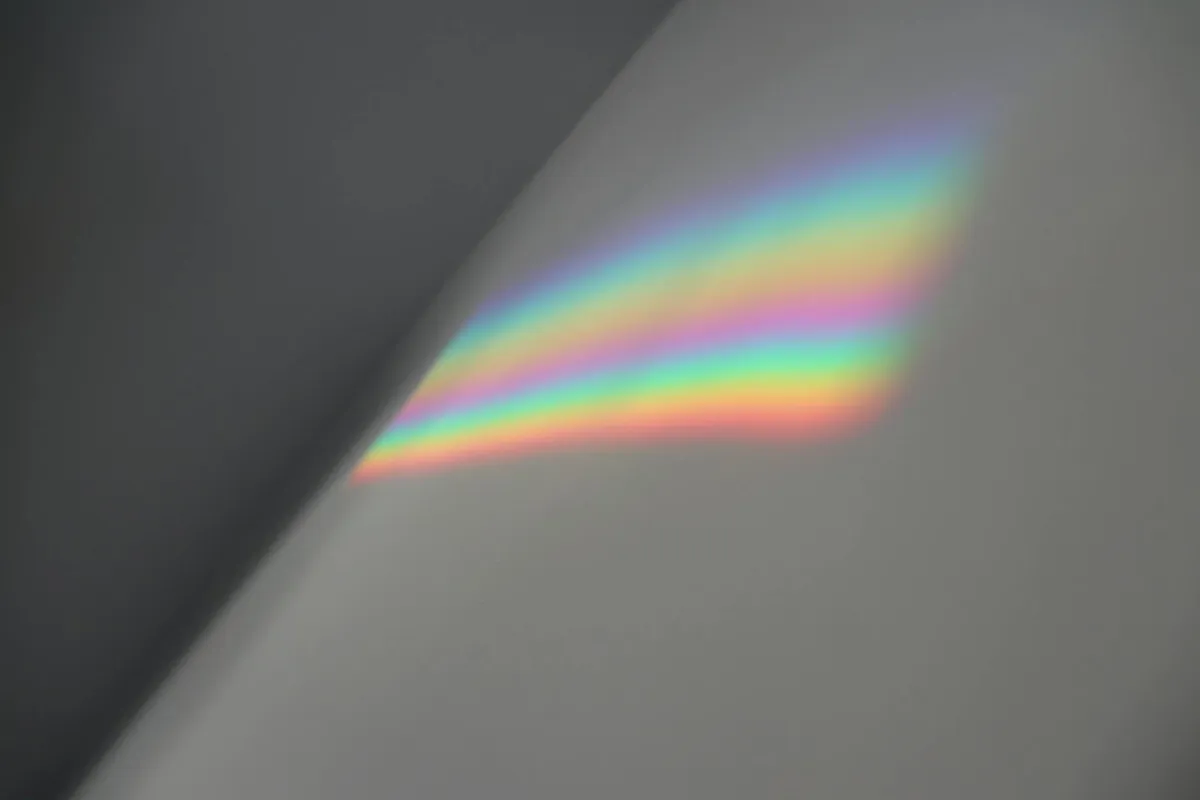
If you pass white light through a glass prism, it spreads into a rainbow. This is familiar. What is less familiar is that the rainbow contains, in its precise pattern of intensities and absences, a complete record of what produced the light and what the light has passed through on its way to the prism.
The instrument that reads this record is a spectrometer. The discipline that interprets the readings is spectroscopy. Together they have been one of the most informative tools in the history of physical science.
What a spectrometer actually does
A spectrometer is an instrument for measuring the spectrum of light — its distribution of intensity across wavelengths. The basic operation: light enters the instrument, is dispersed by a prism or diffraction grating into its component wavelengths, and the intensity at each wavelength is measured by a detector.
The output is a graph: intensity on the vertical axis, wavelength on the horizontal. The shape of this graph carries enormous information.
Different sources of light produce different spectra. A hot solid object (like a tungsten lamp filament) produces a continuous spectrum across all wavelengths, weighted by temperature. A hot gas produces a discrete spectrum — bright lines at specific wavelengths corresponding to electron transitions in its constituent atoms. A cool gas in front of a hotter source produces an absorption spectrum — dark lines at wavelengths that the gas has absorbed from the continuous spectrum behind it.
Each of these patterns is informative. The combination is more so.
The cultural moment of stellar spectroscopy
One of the more striking moments in the history of science was the application of spectroscopy to starlight. In the early nineteenth century, the philosopher Auguste Comte famously argued that humans would never know the chemical composition of the stars, because the stars were too distant for direct sampling. The argument seemed sound.
Within decades of Comte's claim, spectroscopy had proven him wrong. The light from a star, properly analyzed, revealed exactly which chemical elements were present in its outer layers. The dark absorption lines in the stellar spectrum corresponded to specific atomic transitions, identified through laboratory measurements on Earth. Hydrogen, helium, calcium, iron, sodium — all could be detected at distances of hundreds or thousands of light-years.
By the late nineteenth century, astronomers were classifying stars by spectral type. By the early twentieth, spectroscopy had revealed the existence of a previously-unknown element — helium — first detected in the spectrum of the sun before being found on Earth.
The conceptual shift was substantial. Knowledge of the universe was not limited to what humans could directly sample. Light carried information across vast distances, and spectroscopy could read it.
The contemporary applications
Spectroscopy now operates across a much wider range of wavelengths than the visible spectrum that the early instruments measured. Modern spectroscopy includes:
Infrared spectroscopy: reading molecular vibrations, used extensively in chemistry to identify organic compounds.
Ultraviolet spectroscopy: probing electronic transitions, used for chemical analysis and astronomical observation.
X-ray spectroscopy: reading inner-shell atomic transitions, used for elemental analysis of materials.
Mass spectrometry: not light spectroscopy, but the related discipline of measuring the masses of ionized molecules to identify chemical composition.
NMR spectroscopy: nuclear magnetic resonance spectroscopy, reading the magnetic environments of atomic nuclei to determine molecular structure.
Each of these has become foundational to a different scientific or industrial discipline. Modern chemistry, biochemistry, materials science, environmental monitoring, astronomy, and medical imaging all depend extensively on spectroscopic techniques.
The trained reading
What strikes me about spectroscopy as a practice is that, like microscopy, the instrument is the easy part. The harder part is the discipline of interpretation — knowing what features in a spectrum indicate what underlying physical reality.
An experienced spectroscopist can look at a complex spectrum and identify, often within minutes, the major chemical components and their approximate concentrations. The same spectrum shown to a novice reveals nothing.
The interpretation is grounded in knowledge of which atomic and molecular transitions produce which spectral features, at what wavelengths, with what intensities. This knowledge is partly memorized and partly reasoned from physical principles. Years of experience produce what looks like intuitive recognition but is actually compressed analytical reasoning.
The astronomical scale
The aspect of spectroscopy I find most striking is its application to objects at astronomical distances. The light reaching Earth from a distant galaxy left the galaxy hundreds of millions or billions of years ago. Yet that light, properly spectroscopically analyzed, tells us:
- The chemical composition of the galaxy
- The temperature of its stars
- The velocity at which it is moving (through the Doppler shift of its spectral lines)
- The presence of intervening gas clouds along the light's path
- The age of its stellar populations
- Often, the presence of supermassive black holes at its center
The universe is largely opaque to direct investigation. We cannot visit distant galaxies. We cannot sample stars. The light is what reaches us. Spectroscopy is how that light becomes information.
A closing observation
I find spectroscopy interesting partly because it represents a particular kind of indirect knowledge that humans have learned to extract from the physical world. We do not directly perceive the chemical composition of the sun. We perceive light. The chemical composition is inferred through careful interpretation of patterns in that light.
This pattern — direct perception of one thing, indirect inference of another — is central to most of physical science. Spectroscopy is one of its most fully developed expressions.
The light arrives. The instrument disperses it. The graph reveals what was once thought permanently unknowable.